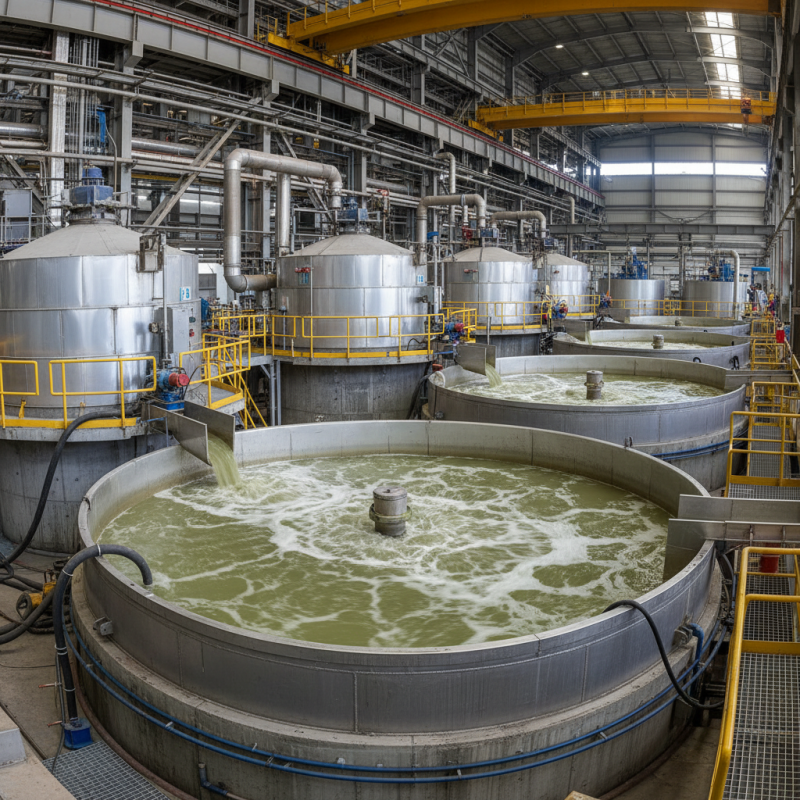
What is Flotation Equipment and How Does it Work?
Flotation Equipment plays a crucial role in mineral processing. It is designed to separate valuable minerals from waste material. Through an innovative process, flotation maximizes the extraction of ores, especially in mining.
The mechanism behind flotation equipment involves adding chemicals to a slurry mixture. Bubbles form and attach to the targeted minerals. This makes them rise to the surface, where they can be collected. It is a delicate balance of chemistry and engineering.
Many industry experts rely on flotation techniques for economic success. However, efficiency can vary. It requires ongoing adjustments to optimize performance. As technology evolves, so does the potential for improved outcomes in flotation systems. This process highlights the need for expertise and continuous learning in mineral processing.
Types of Flotation Equipment Used in Industry
Flotation equipment plays a key role in separating materials based on differences in their physical properties. In various industries, such as mining, it helps refine metals effectively. Several types of flotation equipment serve different needs.
One common type is the mechanical flotation cell. This equipment uses impellers to create turbulence, distributing air bubbles. These bubbles attach to particles, allowing them to float and separate from the slurry. According to a 2021 market report, mechanical flotation cells account for 60% of the market share in mineral processing. Their efficiency in bulk flotation makes them highly regarded among engineers.
Another type is the column flotation cell. This design allows for better separation of finer particles, often achieving recovery rates over 90%. The process involves a counter-current flow of air and slurry. However, results can vary based on operational parameters. In some cases, column flotation may not perform well for certain particle sizes, leading to inefficiencies. Understanding these nuances is vital for optimal operation in industrial applications.
What is Flotation Equipment and How Does it Work?
| Type of Flotation Equipment | Description | Applications |
| Dissolved Air Flotation (DAF) | A water treatment process that clarifies wastewaters by removing suspended solids. | Municipal wastewater treatment, industrial effluent processing. |
| Column Flotation | A flotation technique using a column filled with air bubbles that separates particles based on their surface properties. | Mineral processing, coal cleaning. |
| Froth Flotation | A process that selectively separates hydrophobic materials from hydrophilic ones using air bubbles in a liquid suspension. | Metal ore beneficiation, recycling of plastics. |
| Batch Flotation | A process where a fixed volume of slurry is processed in a flotation cell over a given time period. | Laboratory testing, small-scale operations. |
| Continuous Flotation | A process where slurry is continuously fed into a flotation cell and products are continuously removed. | Large-scale mining operations, industrial recycling. |
Principles of Flotation: How It Separates Minerals
Flotation is a key process in mineral separation. It uses bubbles to capture and separate valuable minerals from ore. The principle relies on the differences in hydrophobicity of mineral surfaces. When air bubbles rise through the slurry, they attach to specific minerals. This attachment allows those minerals to float, while others sink.
Studies reveal that flotation can yield recoveries of over 90% for certain minerals. However, the efficiency varies with ore types. A report by the International Journal of Mineral Processing notes that, under optimal conditions, flotation can achieve a concentration ratio of 10:1. Yet, real-world applications often present challenges. Variables like particle size and chemical reagents affect the flotation performance.
Flotation process optimization is complex. Operators must constantly adjust pulp density and reagent types. This flexibility allows adaptation to changing ore characteristics. However, the risk of suboptimal operations remains. Many plants struggle with inconsistent recovery rates. Continuous monitoring is essential for improving reliability and performance, yet it is often overlooked in practice.
Components of Flotation Equipment and Their Functions
Flotation equipment plays a crucial role in mineral processing. It utilizes the principles of hydrophobicity and gravity to separate valuable minerals from unwanted material. Various components work together harmoniously to achieve this separation effectively.
The flotation cell is the core component. It provides a controlled environment where air bubbles are introduced. These bubbles attach to hydrophobic particles, allowing them to rise and form a froth layer. The froth can be skimmed off, capturing the desired materials. The impeller is another vital part. It circulates the slurry, ensuring adequate mixing and bubble formation.
The addition of reagents is essential for enhancing flotation efficiency. Collectors and frothers modify the surface properties of minerals, promoting their attachment to bubbles. However, managing reagent levels requires careful monitoring. Too much can lead to undesirable interactions and reduce recovery rates. Attention to detail in component operation is critical for maximizing performance in flotation processes. Proper maintenance of the equipment is equally important; neglect can lead to inefficiencies and increased costs.
The Flotation Process: Step-by-Step Breakdown
The flotation process is essential in mineral processing. It separates valuable minerals from waste materials. Let's break it down step by step.
Initially, raw ore is crushed and ground into fine particles. This increases the surface area for the flotation procedure. After grinding, the slurry is mixed with water and chemicals. These chemicals, known as reagents, help to create hydrophobic conditions for the worthwhile minerals. They attach to air bubbles introduced into the mixture.
As the slurry bubbles up, hydrophobic particles attach to these bubbles. They float to the surface, forming a froth. This froth can be skimmed off, collecting the concentrated minerals. The remaining materials sink, allowing for further processing. This method emphasizes the importance of precise control over the conditions for effective separation. Each step is critical, and small changes can drastically impact outcomes.
Understanding this process requires both theoretical and practical knowledge. Challenges often arise, such as reagent efficiency and bubble size. Continuous adjustment is necessary to ensure optimal results in mineral recovery.
Applications of Flotation Equipment in Mining and Recycling
Flotation equipment plays a vital role in the mining and recycling industries. In mining, it helps separate valuable minerals from ores. The process relies on the differences in hydrophobicity of materials. By adding chemicals, desired minerals cling to air bubbles. Intricate machinery facilitates this process, allowing minerals to rise to the surface. The result is a concentrated mineral product that can be processed further.
In the recycling sector, flotation equipment aids in recovering materials from waste. For example, plastics and metals can be efficiently separated using flotation methods. The equipment targets specific materials based on their surface properties. This process can increase the purity of recycled materials, making them more valuable. Recycling processes face challenges, such as varying compositions of waste. Continuous improvement and innovation in flotation technology are necessary to enhance recovery rates.